
Open any Digital marketing dashboard today and it looks impressive.
Graphs are climbing. Numbers are glowing green. Percentages are smiling back at you.
But the painful truth is something no one wants to admit.
Most Digital marketing dashboards lie.
Not because the tools are broken.
Not because the data is fake.
But because the Digital marketing metrics we choose to highlight often hide the real story.
If you’ve ever felt confident after seeing high traffic, massive impressions, or growing followers yet still wondered “Why isn’t my business growing?” this article is for you.

Let’s break the illusion, expose misleading Digital marketing metrics, and identify the few metrics you can actually trust.
The Dashboard Illusion: When Numbers Create False Confidence
Digital dashboards were built to simplify decision-making. Ironically, they now do the opposite.
Most dashboards:
Show too many metrics
Prioritize vanity over value
Ignore business outcomes
A typical dashboard proudly displays:
Website sessions
Impressions
Clicks
Follower growth
CTR percentages
These Digital marketing metrics look impressive but they often distract from what really matters: revenue, retention, and real customer behavior.
Why Most Digital Marketing Metrics Are Designed to Look Good
Here’s a hard truth:
Most marketing tools are designed to make marketers feel successful, not accountable.
Platforms benefit when you:
Run more ads
Spend more budget
Stay longer inside the tool
So the default Digital marketing metrics emphasize:
Volume over quality
Activity over impact
Visibility over profitability
This is why dashboards highlight impressions instead of conversions and engagement instead of customer value.
3.Vanity Metrics: The Biggest Dashboard Liars

Let’s talk about the most misleading Digital marketing metrics the ones that lie without technically being false.
3.1. Impressions: Seen Does Not Mean Felt
Impressions count how many times your content appeared on a screen.
Example:
Your ad shows up while someone scrolls fast
The tab is open in the background
The screen is locked
Yet the impression still counts.
Impressions are one of the weakest Digital marketing metrics because:
They don’t measure attention
They don’t measure interest
They don’t measure intent
They only measure exposure nothing more.
3.2. Website Traffic: Popular But Misunderstood
High traffic feels like success.
But traffic alone is a hollow Digital marketing metric.
Example:
A brand drives 100,000 visitors through viral reels.
Bounce rate: 92%
Time on site: 7 seconds
Conversions: 0.3%
The dashboard celebrates traffic growth, but the business sees no growth.
Traffic without relevance is just noise.
3.3. Click-Through Rate (CTR): The Half Truth
CTR is often glorified as a performance indicator.
But here’s the catch:
Clicks don’t equal conversions
Clicks don’t equal customers
Example:
A sensational headline gets clicks:
“Earn ₹1 Lakh Per Month With Zero Skills”
CTR skyrockets.
Conversions crash.
CTR as a standalone Digital marketing metric encourages clickbait not trust.
3.4. Social Media Followers: The Ego Metric
Follower count is one of the most overrated Digital marketing metrics in existence.
Example:
50,000 followers
200 likes per post
3 comments (mostly emojis)
Zero leads
Followers don’t pay bills. Customers do.
4.Why Dashboards Lie Even When Data Is Correct
Here’s the deeper issue:
Dashboards lie through context, not data.
They show:
What happened
Not why it happened
Not what to do next
Most Digital marketing metrics are descriptive, not diagnostic or predictive.
They tell you what, but not so what.
Metrics vs Reality: A Real Campaign Example
Let’s look at a real-world style scenario.
5.1 Campaign A (Looks Successful on Dashboard)
Impressions is 1.2 million
Click Through Rate is 3.8%
Traffic is 45000
Engagement is High
5.2 Campaign B -Looks Average on Dashboard
Impressions is 120,000
Click Through Rate : 1.1%
Traffic is 4,500
Engagement: Low
5.3 The Business Reality
Campaign A
Sales is 18,000
Refunds: High
Customer quality: Poor
Campaign B:
Sales is ₹3,40,000
Repeat customers: High
LTV: Strong
Dashboards praised Campaign A because the Digital marketing metrics looked impressive.
But the business should double down on Campaign B.
6. Digital Marketing Metrics You Can Actually Trust
Now let’s talk about Digital marketing metrics that reflect reality not illusion.
6.1. Conversion Rate (Quality Conversions)
Not just any conversion meaningful conversions.
Trust conversions that:
Lead to revenue
Lead to qualified leads
Match your business goal
A lower traffic source with higher conversion is more valuable than massive low-intent traffic.
6.2. Cost Per Acquisition (CPA)
CPA is one of the most honest Digital marketing metrics because it ties directly to cost and outcome.
If you:
Spend amount 10,000
Acquire 10 customers
Your CPA is ₹1,000 no storytelling can hide that.
6.3. Customer Lifetime Value (LTV)
LTV indicates the actual value of a customer
Example:
Customer A buys once for ₹1,000
Customer B buys every month for a year
Dashboards focused on clicks will favor Customer A traffic.
Smart Digital marketing metrics prioritize Customer B.
6.4. Retention Rate
Retention exposes whether your marketing attracts the right people.
High churn = misleading acquisition metrics.
Retention-focused Digital marketing metrics show long-term success not short-term excitement.
6.5. Assisted Conversions
Many dashboards credit only the last click.
But real journeys are complex:
Instagram → Google Search → Website → Email → Purchase
Trust Digital marketing metrics that show assists, not just last interaction.
7. The Danger of “Average” Metrics
Averages hide extremes.
Example:
Average time on site is 3 minutes
Reality:
80% leave in 5 seconds
20% stay for 12 minutes
Dashboards love averages because they smooth out problems.
Smart marketers dig deeper into Digital marketing metrics distributions.
8. Why Business Owners Lose Trust in Marketing
Most business owners don’t hate marketing.
They hate misleading Digital marketing metrics.
They hear:
“Traffic increased”
“Reach doubled”
“Engagement improved”
But they feel:
Cash flow pressure
No sales growth
No clarity
This gap is where trust breaks.
9. How to create a truthful Dashboard
A truthful dashboard:
Shows fewer metrics
Connects marketing to money
Forces uncomfortable conversations
Your dashboard should answer:
Are we acquiring the right customers?
Are we profitable?
What should we stop doing?
If a Digital marketing metric doesn’t help answer these, remove it.
10. A Simple Rule to Identify Lying Metrics
Ask this question:
“if this metric goes up, will my business definitely benefit ?”
If the answer is no, this metric is a vanity metric.
Strong Digital marketing metrics survive this test.
11. Final Truth: Metrics Don’t Lie, But Dashboards Do
Let’s be clear.
Metrics themselves aren’t evil.
Dashboards aren’t useless.
But Digital marketing metrics without context, intent, and business alignment create false confidence.
The best marketers are not the ones with the most elegant dashboards.
They are the ones who,
Question their numbers
Challenge assumptions
Concentrate on outcomes, not recognition
If your dashboard makes you comfortable, it’s probably lying.
If it makes you uncomfortable but profitable it’s finally telling the truth.
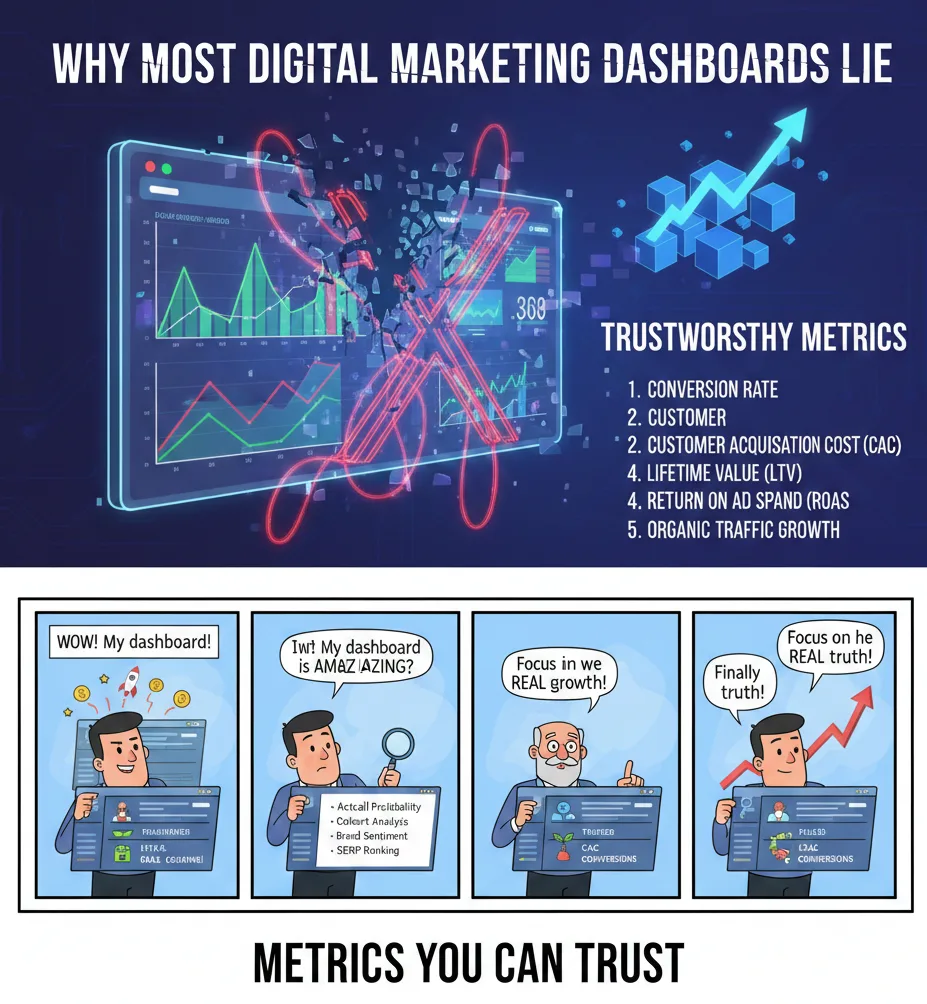
In the end, it is individuals who can distill truth into their interpretation, rather than simply distill numbers, who will own the future of marketing. As tools become more intelligent, marketing dashboards will become even more persuasive persuasion is not performance.
The art is in filtering out the noise, allowing a true understanding of what is driving true growth. By harmonizing on the right Digital Marketing Metrics, strategy should become easier, budgets smarter, and outcomes predictable. Stop wondering what your dashboard is saying in a boardroom, start wondering what it does in the real world. When you start believing in the right Digital Marketing Metrics, marketing should become less art, less guesswork, and more machine.
If you want to see how these Digital Marketing Metrics are applied beyond theory and dashboards, reviewing real campaigns makes the difference. Numbers become meaningful only when they are tied to revenue, retention, and long-term growth not just screenshots and reports.
For practical examples, real performance breakdowns, and conversion-focused marketing work, you can explore my portfolio here:
https://aneeshkamal.com
This is where Digital Marketing Metrics are treated as business indicators, not vanity signals — focusing on what actually moves growth in the real world.